مرصد حوسبة العربيَّة لعام (٢٠٢٥م) مرجعك في مستجدَّات الحوسبة العربيَّة

Welcome to the First Edition of the Arabic NLP Observatory


The Arabic NLP Observatory is an analytical and reference tool that aims to document and monitor developments in this vital field. The first report of the Observatory seeks to provide a general overview of the state of Arabic Natural Language Processing up to the end of the year [20XX]. It covers linguistic resources and data, technical tools, large language models, model evaluation metrics, research and development areas, education and training, as well as future challenges and opportunities.

Highlights of the Summaries

  • Arabic NLP Tools: Significant Progress Amid Ongoing Challenges

    Arabic natural language processing (NLP) tools have made major strides in developing advanced solutions for syntactic analysis, diacritization, and named entity recognition. However, noticeable gaps remain—such as limited support for Arabic dialects and a lack of clear licensing. While most tools are open-source, fostering community-driven innovation, stronger collaboration between academic institutions and industry is essential to accelerate development and enhance linguistic inclusivity.
  • Arabic NLP: A Cornerstone of the Digital Future

    With its rich morphology and dialectal variety, Arabic represents a central pillar of the Arab and Islamic cultural and religious heritage—it is the language of the Qur’an and the Prophet’s Sunnah. The rise of AI and large language models highlights the need for concerted efforts to build effective systems that can understand and generate Arabic, ensuring the preservation of its identity in the digital age.
  • Arabic Language Models: Development Opportunities Amid Persistent Challenges

    Arabic language models are a critical component of AI applications, yet their development is hindered by fragmented research efforts. These challenges also present an opportunity to unify regional efforts, invest in advanced digital infrastructure, support collaborative research initiatives, and facilitate the exchange of expertise among stakeholders.
  • Arabic Linguistic Data: A Cornerstone for AI Development, Facing Quality and Diversity Challenges

    Arabic linguistic data is a vital driver of innovation in AI applications such as machine translation, sentiment analysis, and dialect recognition. However, the lack of high-quality annotated data and the absence of clear licensing frameworks remain significant obstacles. Addressing these gaps requires better data documentation, open licensing policies, and the development of advanced AI tools to annotate data accurately—while accounting for the linguistic and cultural diversity of the Arabic language.
  • Advancing Arabic NLP Research: Strengthening Regional Collaboration

    Statistics reveal a gap between Arabic NLP research and its counterparts in other languages, both in quantity and in focus on cutting-edge topics like large language models. To make tangible progress, regional collaborative platforms must be established to connect academic and industrial institutions, with an emphasis on unifying efforts to build open-source, well-documented resources that reflect the linguistic and cultural diversity of Arabic.
  • Evaluating Language Model Accuracy: Bridging Evaluation Gaps

    Despite notable advancements in Arabic language models, the lack of comprehensive, accurate, and transparent evaluation standards limits their ability to match the performance of multilingual models. Key challenges include reliance on translated texts and insufficient representation of dialects. There is a pressing need to develop specialized evaluation benchmarks based on native data to expand innovation and enable models to meet the needs of diverse users.
  • Enhancing Arabic NLP: Bridging Structural Gaps

    Arabic NLP faces structural challenges that hinder progress—including the lack of high-quality annotated data, insufficient specialized tools, and weak collaboration between research and industry. These issues represent a gap in both technical infrastructure and skilled human resources. Real advancement requires a comprehensive strategy focusing on the development of annotated datasets that reflect Arabic’s linguistic and cultural diversity—including dialects and domain-specific texts—along with improvements in software tools and the promotion of joint research projects linking academia with industry. Sustainable funding is also essential to accelerate innovation and translate research into practical applications, ultimately building a cohesive tech ecosystem that supports Arabic and broadens its use in various technological fields.
  • Specialization in Arabic NLP: Lack of Academic Programs

    Specialized academic programs in Arabic NLP remain limited, impeding the development of human capacity in the field. With the growing demand for AI and language processing, there is an increasing need to create educational pathways that include Arabic NLP at the undergraduate and graduate levels, in addition to launching training initiatives aimed at preparing students from the secondary level onward.
  • Arabic in NLP Research: Arabization of Terms and Specialized Courses

    One of the challenges facing Arabic NLP is the tendency of researchers to use English in documenting their work, presenting their studies, and delivering courses—given the dominance of English in AI research. This causes difficulties in fully grasping the nuances of linguistic analysis. There is a clear need to intensify efforts to Arabize this critical field, standardize its terminology, and enrich its Arabic-language content.
  • The Gap Between Computational and Linguistic Experts: Bridging Divides and Building Joint Programs

    Linguists interested in Arabic NLP often struggle to stay up-to-date with the latest developments due to issues such as differing terminologies and cultural backgrounds. Likewise, computational experts working on linguistic data face challenges in collaborating with linguists—due to a shortage of specialists and differences in methodologies and annotation guidelines. Joint programs are therefore essential to develop models, tools, and training resources, along with intensified efforts to deliver courses on linguistic data annotation aligned with AI development methodologies.

Chapters of the Report

Executive Summary
The Chair reviews the executive summary, introduction to the Observatory, its objectives, methodology, key findings from the report, chapters, and the Observatory in figures.
Example Link Download the data Example Link Download the executive summary

Chapter One: An Overview of Arabic Natural Language Processing
This chapter discusses the development of language models used in generating and analyzing Arabic texts, reviewing their evolution since 2020, with a focus on Arabic language models. It traces their recent advancements up to the applications that have brought about a qualitative leap in various fields, and highlights the technological innovations that have enhanced the understanding and processing of the Arabic language.
Example Link Download the data Example Link Download Chapter One
The Development of Published Research in the Field of Arabic Natural Language Processing (1980)
Tab select
The Development of Applying Machine Learning Techniques in Arabic Natural Language Processing Research since 2010
Tab select

The results showed that 56% of the participants classified the availability of data as insufficient. These results indicate that the majority of participants find the available data either inadequate or difficult to access, which creates an obstacle to the progress of their research or industrial projects and limits the ability to develop effective solutions in the field of Arabic natural language processing.

The results also show that nearly 37% of participants believe that the tools do not meet the needs, while about 52% reported that the digital infrastructure does not support the requirements of their projects. Furthermore, 71% of participants acknowledged that research collaboration is ineffective. This assessment highlights a gap in collaborative efforts between the academic and industrial sectors, which leads to delays in translating research into practical applications.

The findings further reveal that around 25% of participants are satisfied with the quality of published research in this field, while nearly 78% noted that financial support and funding are insufficient. This was the highest-rated challenge, indicating that funding constitutes a major obstacle to progress in this area. The evaluation also shows that about 40% of participants are dissatisfied with the level of human capacity in Arabic NLP, pointing to a gap in the linguistic and technical skills required to support Arabic NLP projects.

Although 38% of participants relatively share their expertise and knowledge, this contribution is still insufficient to achieve the desired level of knowledge exchange, underscoring the need to strengthen efforts to increase both the scale and quality of knowledge sharing among specialists.

Chapter Two: Tools and Technological Solutions
This chapter discusses the development of language models used in generating and analyzing Arabic texts, reviewing their evolution since 2020, with a focus on Arabic language models. It traces their recent advancements up to the applications that have brought about a qualitative leap in various fields, and highlights the technological innovations that have enhanced the understanding and processing of the Arabic language.
Example Link Download the data Example Link Download Chapter Two
Distribution of Arabic language processing tools by task
Tab select
Distribution of Arabic language processing tools by publication date
Tab select
Distribution of Arabic language processing tools by code accessibility (QR/code)
Tab select
Distribution of Arabic language processing tools by publisher
Tab select
Distribution of tools’ support for dialects
Tab select
Distribution of tools’ support for dialects by task variety
Tab select
Distribution of Arabic language processing tools by programming language used for development
Tab select
Distribution of Arabic language processing tools by interaction method
Tab select
Distribution of Arabic language processing tools by hosting platform
Tab select
يظهر الرَّسم البيانيُّ توزيع أدوات المعالجة الآليَّة للُّغة العربيَّة بحسب المهام المختلفة. ويُلاحَظ أنَّ أدوات التَّحليل النَّحويِّ أكثرها استخدامًا في هذه المهام؛ إذ تتصدَّر القائمة بأكبر نسبة، تليها أدوات توليد النُّصوص، وأدوات التَّحليل الصرفيِّ، ويبيِّن ذلك أنَّ أغلب الأبحاث والممارسات الحاليَّة تركِّز على تحسين فهم البنيتين (النَّحويَّة والصَّرفيَّة) للُّغة العربيَّة، وتأتي في المراتب التَّالية: أدوات التَّعرُّف إلى الكلام الصَّوتيِّ، والتَّعرُّف الصَّوتي إلى الحروف؛ ممَّا يشير إلى ازدياد الاهتمام بتقنيات التَّعرُّف الصَّوتيِّ في المعالجة الآليَّة للُّغة العربيَّة.

The results also show that nearly 37% of participants believe that the tools do not meet the needs, while about 52% reported that the digital infrastructure does not support the requirements of their projects. Furthermore, 71% of participants acknowledged that research collaboration is ineffective. This assessment highlights a gap in collaborative efforts between the academic and industrial sectors, which leads to delays in translating research into practical applications.

The findings further reveal that around 25% of participants are satisfied with the quality of published research in this field, while nearly 78% noted that financial support and funding are insufficient. This was the highest-rated challenge, indicating that funding constitutes a major obstacle to progress in this area. The evaluation also shows that about 40% of participants are dissatisfied with the level of human capacity in Arabic NLP, pointing to a gap in the linguistic and technical skills required to support Arabic NLP projects.
 

this field, while nearly 78% noted that financial support and funding are insufficient. This was the highest-rated challenge, indicating that funding constitutes a major obstacle to progress in this area. The evaluation also shows that about 40% of participants are dissatisfied with the level of human capacity in Arabic NLP, pointing to a gap in the linguistic and technical skills required to support Arabic NLP projects.
The results also show that nearly 37% of participants believe that the tools do not meet the needs, while about 52% reported that the digital infrastructure does not support the requirements of their projects. Furthermore, 71% of participants acknowledged that research collaboration is ineffective. This assessment highlights a gap in collaborative efforts between the academic and industrial sectors, which leads to delays in translating research into practical applications.
The results showed that 56% of the participants classified the availability of data as insufficient. These results indicate that the majority of participants find the available data either inadequate or difficult to access, which creates an obstacle to the progress of their research or industrial projects and limits the ability to develop effective solutions in the field of Arabic natural language processing.

The findings further reveal that around 25% of participants are satisfied with the quality of published research in this field, while nearly 78% noted that financial support and funding are insufficient. This was the highest-rated challenge, indicating that funding constitutes a major obstacle to progress in this area. The evaluation also shows that about 40% of participants are dissatisfied with the level of human capacity in Arabic NLP, pointing to a gap in the linguistic and technical skills required to support Arabic NLP projects.

Although 38% of participants relatively share their expertise and knowledge, this contribution is still insufficient to achieve the desired level of knowledge exchange, underscoring the need to strengthen efforts to increase both the scale and quality of knowledge sharing among specialists.

The results also show that nearly 37% of participants believe that the tools do not meet the needs, while about 52% reported that the digital infrastructure does not support the requirements of their projects. Furthermore, 71% of participants acknowledged that research collaboration is ineffective. This assessment highlights a gap in collaborative efforts between the academic and industrial sectors, which leads to delays in translating research into practical applications.

The findings further reveal that around 25% of participants are satisfied with the quality of published research in this field, while nearly 78% noted that financial support and funding are insufficient. This was the highest-rated challenge, indicating that funding constitutes a major obstacle to progress in this area. The evaluation also shows that about 40% of participants are dissatisfied with the level of human capacity in Arabic NLP, pointing to a gap in the linguistic and technical skills required to support Arabic NLP projects.

The results showed that 56% of the participants classified the availability of data as insufficient. These results indicate that the majority of participants find the available data either inadequate or difficult to access, which creates an obstacle to the progress of their research or industrial projects and limits the ability to develop effective solutions in the field of Arabic natural language processing.

The results also show that nearly 37% of participants believe that the tools do not meet the needs, while about 52% reported that the digital infrastructure does not support the requirements of their projects. Furthermore, 71% of participants acknowledged that research collaboration is ineffective. This assessment highlights a gap in collaborative efforts between the academic and industrial sectors, which leads to delays in translating research into practical applications.


Chapter Three: Data
This chapter discusses the development of language models used in generating and analyzing Arabic texts, reviewing their evolution since 2020, with a focus on Arabic language models. It traces their recent advancements up to the applications that have brought about a qualitative leap in various fields, and highlights the technological innovations that have enhanced the understanding and processing of the Arabic language.
Example Link Download the data Example Link Download Chapter Three
Number of Arabic datasets published from 2000 to 2024
Tab select
Distribution of the ten most common tasks in Arabic linguistic datasets
Tab select
Distribution of the ten most common tasks in Arabic linguistic datasets from 2000 to 2024
Tab select
Distribution of datasets by their classification
Tab select
Distribution of datasets by the number of languages included
Tab select
Distribution of datasets by dialects
Tab select
Licenses used in Arabic linguistic datasets
Tab select
Distribution of Arabic linguistic datasets by repositories
Tab select
Enumeration of methods used for dataset creation
Tab select
Number of Arabic words in each corpus
Tab select

The findings further reveal that around 25% of participants are satisfied with the quality of published research in this field, while nearly 78% noted that financial support and funding are insufficient. This was the highest-rated challenge, indicating that funding constitutes a major obstacle to progress in this area. The evaluation also shows that about 40% of participants are dissatisfied with the level of human capacity in Arabic NLP, pointing to a gap in the linguistic and technical skills required to support Arabic NLP projects.

Although 38% of participants relatively share their expertise and knowledge, this contribution is still insufficient to achieve the desired level of knowledge exchange, underscoring the need to strengthen efforts to increase both the scale and quality of knowledge sharing among specialists.

The results also show that nearly 37% of participants believe that the tools do not meet the needs, while about 52% reported that the digital infrastructure does not support the requirements of their projects. Furthermore, 71% of participants acknowledged that research collaboration is ineffective. This assessment highlights a gap in collaborative efforts between the academic and industrial sectors, which leads to delays in translating research into practical applications.

The findings further reveal that around 25% of participants are satisfied with the quality of published research in this field, while nearly 78% noted that financial support and funding are insufficient. This was the highest-rated challenge, indicating that funding constitutes a major obstacle to progress in this area. The evaluation also shows that about 40% of participants are dissatisfied with the level of human capacity in Arabic NLP, pointing to a gap in the linguistic and technical skills required to support Arabic NLP projects.

Although 38% of participants relatively share their expertise and knowledge, this contribution is still insufficient to achieve the desired level of knowledge exchange, underscoring the need to strengthen efforts to increase both the scale and quality of knowledge sharing among specialists.

The results showed that 56% of the participants classified the availability of data as insufficient. These results indicate that the majority of participants find the available data either inadequate or difficult to access, which creates an obstacle to the progress of their research or industrial projects and limits the ability to develop effective solutions in the field of Arabic natural language processing.

The results also show that nearly 37% of participants believe that the tools do not meet the needs, while about 52% reported that the digital infrastructure does not support the requirements of their projects. Furthermore, 71% of participants acknowledged that research collaboration is ineffective. This assessment highlights a gap in collaborative efforts between the academic and industrial sectors, which leads to delays in translating research into practical applications.

The findings further reveal that around 25% of participants are satisfied with the quality of published research in this field, while nearly 78% noted that financial support and funding are insufficient. This was the highest-rated challenge, indicating that funding constitutes a major obstacle to progress in this area. The evaluation also shows that about 40% of participants are dissatisfied with the level of human capacity in Arabic NLP, pointing to a gap in the linguistic and technical skills required to support Arabic NLP projects.

Although 38% of participants relatively share their expertise and knowledge, this contribution is still insufficient to achieve the desired level of knowledge exchange, underscoring the need to strengthen efforts to increase both the scale and quality of knowledge sharing among specialists.

The findings further reveal that around 25% of participants are satisfied with the quality of published research in this field, while nearly 78% noted that financial support and funding are insufficient. This was the highest-rated challenge, indicating that funding constitutes a major obstacle to progress in this area. The evaluation also shows that about 40% of participants are dissatisfied with the level of human capacity in Arabic NLP, pointing to a gap in the linguistic and technical skills required to support Arabic NLP projects.

The results showed that 56% of the participants classified the availability of data as insufficient. These results indicate that the majority of participants find the available data either inadequate or difficult to access, which creates an obstacle to the progress of their research or industrial projects and limits the ability to develop effective solutions in the field of Arabic natural language processing.

The results also show that nearly 37% of participants believe that the tools do not meet the needs, while about 52% reported that the digital infrastructure does not support the requirements of their projects. Furthermore, 71% of participants acknowledged that research collaboration is ineffective. This assessment highlights a gap in collaborative efforts between the academic and industrial sectors, which leads to delays in translating research into practical applications.

Although ٣٨% of participants relatively share their expertise and knowledge, this contribution is still insufficient to achieve the desired level of knowledge exchange, underscoring the need to strengthen efforts to increase both the scale and quality of knowledge sharing among specialists.

Chapter Four: Language Models for Arabic NLP
This chapter discusses the development of language models used in generating and analyzing Arabic texts, reviewing their evolution since 2020, with a focus on Arabic language models. It traces their recent advancements up to the applications that have brought about a qualitative leap in various fields, and highlights the technological innovations that have enhanced the understanding and processing of the Arabic language.
Example Link Download the data Example Link Download Chapter Four
Number of model downloads by type on HuggingFace
Tab select
Development timeline of language models from ٢٠٢٠ to ٢٠٢٤
Tab select
Number of models by architecture
Tab select
Number of Arabic and English language parameters for Arabic models (in billions)
Tab select

The findings further reveal that around 25% of participants are satisfied with the quality of published research in this field, while nearly 78% noted that financial support and funding are insufficient. This was the highest-rated challenge, indicating that funding constitutes a major obstacle to progress in this area. The evaluation also shows that about 40% of participants are dissatisfied with the level of human capacity in Arabic NLP, pointing to a gap in the linguistic and technical skills required to support Arabic NLP projects.

Although 38% of participants relatively share their expertise and knowledge, this contribution is still insufficient to achieve the desired level of knowledge exchange, underscoring the need to strengthen efforts to increase both the scale and quality of knowledge sharing among specialists.

The results showed that ٥٦% of the participants classified the availability of data as insufficient. These results indicate that the majority of participants find the available data either inadequate or difficult to access, which creates an obstacle to the progress of their research or industrial projects and limits the ability to develop effective solutions in the field of Arabic natural language processing.

The results also show that nearly ٣٧% of participants believe that the tools do not meet the needs, while about ٥٢% reported that the digital infrastructure does not support the requirements of their projects. Furthermore, ٧١% of participants acknowledged that research collaboration is ineffective. This assessment highlights a gap in collaborative efforts between the academic and industrial sectors, which leads to delays in translating research into practical applications.

The results showed that 56% of the participants classified the availability of data as insufficient. These results indicate that the majority of participants find the available data either inadequate or difficult to access, which creates an obstacle to the progress of their research or industrial projects and limits the ability to develop effective solutions in the field of Arabic natural language processing.

The results also show that nearly 37% of participants believe that the tools do not meet the needs, while about 52% reported that the digital infrastructure does not support the requirements of their projects. Furthermore, 71% of participants acknowledged that research collaboration is ineffective. This assessment highlights a gap in collaborative efforts between the academic and industrial sectors, which leads to delays in translating research into practical applications.

The findings further reveal that around 25% of participants are satisfied with the quality of published research in this field, while nearly 78% noted that financial support and funding are insufficient. This was the highest-rated challenge, indicating that funding constitutes a major obstacle to progress in this area. The evaluation also shows that about 40% of participants are dissatisfied with the level of human capacity in Arabic NLP, pointing to a gap in the linguistic and technical skills required to support Arabic NLP projects.

Although 38% of participants relatively share their expertise and knowledge, this contribution is still insufficient to achieve the desired level of knowledge exchange, underscoring the need to strengthen efforts to increase both the scale and quality of knowledge sharing among specialists.


Chapter Five: Maturity Indicators of Large Language Models
This chapter discusses the development of language models used in generating and analyzing Arabic texts, reviewing their evolution since 2020, with a focus on Arabic language models. It traces their recent advancements up to the applications that have brought about a qualitative leap in various fields, and highlights the technological innovations that have enhanced the understanding and processing of the Arabic language.
Example Link Download the data Example Link Download Chapter Five
Distribution of the number of evaluation metrics for large language models from 2020 to 2024
Tab select
Country distribution in the data section of the ARGEN benchmark
Tab select
Classification of task and data sets in the ORCA benchmark
Tab select
Classification of task sets in the Dolphin benchmark
Tab select
Average model performance compared to the latest state-of-the-art (SOTA) models
Tab select
Distribution of educational levels and corresponding subjects in the ArabicMMLU benchmark
Tab select
Data distribution in the BALSAM benchmark across specified categories
Tab select

The results showed that 56% of the participants classified the availability of data as insufficient. These results indicate that the majority of participants find the available data either inadequate or difficult to access, which creates an obstacle to the progress of their research or industrial projects and limits the ability to develop effective solutions in the field of Arabic natural language processing.

The results also show that nearly 37% of participants believe that the tools do not meet the needs, while about 52% reported that the digital infrastructure does not support the requirements of their projects. Furthermore, 71% of participants acknowledged that research collaboration is ineffective. This assessment highlights a gap in collaborative efforts between the academic and industrial sectors, which leads to delays in translating research into practical applications.

The findings further reveal that around ٢٥% of participants are satisfied with the quality of published research in this field, while nearly ٧٨% noted that financial support and funding are insufficient. This was the highest-rated challenge, indicating that funding constitutes a major obstacle to progress in this area. The evaluation also shows that about ٤٠% of participants are dissatisfied with the level of human capacity in Arabic NLP, pointing to a gap in the linguistic and technical skills required to support Arabic NLP projects.
The findings further reveal that around 25% of participants are satisfied with the quality of published research in this field, while nearly 78% noted that financial support and funding are insufficient. This was the highest-rated challenge, indicating that funding constitutes a major obstacle to progress in this area. The evaluation also shows that about 40% of participants are dissatisfied with the level of human capacity in Arabic NLP, pointing to a gap in the linguistic and technical skills required to support Arabic NLP projects.

The results showed that 56% of the participants classified the availability of data as insufficient. These results indicate that the majority of participants find the available data either inadequate or difficult to access, which creates an obstacle to the progress of their research or industrial projects and limits the ability to develop effective solutions in the field of Arabic natural language processing.

The results also show that nearly 37% of participants believe that the tools do not meet the needs, while about 52% reported that the digital infrastructure does not support the requirements of their projects. Furthermore, 71% of participants acknowledged that research collaboration is ineffective. This assessment highlights a gap in collaborative efforts between the academic and industrial sectors, which leads to delays in translating research into practical applications.

The findings further reveal that around 25% of participants are satisfied with the quality of published research in this field, while nearly 78% noted that financial support and funding are insufficient. This was the highest-rated challenge, indicating that funding constitutes a major obstacle to progress in this area. The evaluation also shows that about 40% of participants are dissatisfied with the level of human capacity in Arabic NLP, pointing to a gap in the linguistic and technical skills required to support Arabic NLP projects.

Although 38% of participants relatively share their expertise and knowledge, this contribution is still insufficient to achieve the desired level of knowledge exchange, underscoring the need to strengthen efforts to increase both the scale and quality of knowledge sharing among specialists.


Chapter Six: Research and Development
This chapter discusses the development of language models used in generating and analyzing Arabic texts, reviewing their evolution since 2020, with a focus on Arabic language models. It traces their recent advancements up to the applications that have brought about a qualitative leap in various fields, and highlights the technological innovations that have enhanced the understanding and processing of the Arabic language.
Example Link Download the data Example Link Download Chapter Six
Number of research papers published in the past ten years (including 2024 up to mid-December) across various databases
Tab select
Percentage of research papers focused on the Arabic language among all papers on the Association for Computational Linguistics (ACL) website during the past ten years (including 2024 up to mid-December)
Tab select
Distribution of research types published on the Web of Science (WOS) regarding Arabic language processing over the past ten years
Tab select
Distribution of research types published in the DBLP database related to Arabic language processing over the past ten years
Tab select
Top 10 main topics for all languages according to the Association for Computational Linguistics (ACL) website up to 2024
Tab select
Top 10 main topics for the Arabic language according to the Association for Computational Linguistics (ACL) website up to 2024
Tab select
Number of patent applications in Arabic language processing from 2014 to 2024
Tab select

The findings further reveal that around 25% of participants are satisfied with the quality of published research in this field, while nearly 78% noted that financial support and funding are insufficient. This was the highest-rated challenge, indicating that funding constitutes a major obstacle to progress in this area. The evaluation also shows that about 40% of participants are dissatisfied with the level of human capacity in Arabic NLP, pointing to a gap in the linguistic and technical skills required to support Arabic NLP projects.

Although 38% of participants relatively share their expertise and knowledge, this contribution is still insufficient to achieve the desired level of knowledge exchange, underscoring the need to strengthen efforts to increase both the scale and quality of knowledge sharing among specialists.


Chapter Seven: Education and Capacity Building
This chapter discusses the development of language models used in generating and analyzing Arabic texts, reviewing their evolution since 2020, with a focus on Arabic language models. It traces their recent advancements up to the applications that have brought about a qualitative leap in various fields, and highlights the technological innovations that have enhanced the understanding and processing of the Arabic language.
Example Link Download the data Example Link Download Chapter Seven
Average computer specialization compared to other specializations (percentage)
Tab select
Number of courses taught in English related to artificial intelligence worldwide
Tab select
Distribution of training and educational courses related to artificial intelligence and natural language processing by the language in which they were offered
Tab select
Distribution of training and educational courses related to artificial intelligence and natural language processing by level
Tab select
Number of students enrolled in training and educational courses related to artificial intelligence and natural language processing by course level
Tab select
Number of training hours for courses related to artificial intelligence and natural language processing
Tab select
Number of jobs in data and artificial intelligence fields by global geographic distribution
Tab select
Percentage of Arabic language processing jobs compared to natural language processing in general in Saudi Arabia
Tab select

The findings further reveal that around 25% of participants are satisfied with the quality of published research in this field, while nearly 78% noted that financial support and funding are insufficient. This was the highest-rated challenge, indicating that funding constitutes a major obstacle to progress in this area. The evaluation also shows that about 40% of participants are dissatisfied with the level of human capacity in Arabic NLP, pointing to a gap in the linguistic and technical skills required to support Arabic NLP projects.

Although 38% of participants relatively share their expertise and knowledge, this contribution is still insufficient to achieve the desired level of knowledge exchange, underscoring the need to strengthen efforts to increase both the scale and quality of knowledge sharing among specialists.

The chart illustrates the distribution of training and educational courses related to artificial intelligence and natural language processing according to the language in which they were delivered. A total of 85.8% of the courses were offered in English, while only 14.2% were provided in Arabic. This distribution reflects a clear gap in the availability of Arabic-language educational content related to artificial intelligence and natural language processing compared to other languages, particularly English. It highlights the importance of strengthening Arabic-language content in these fields to meet the needs of Arabic speakers and to expand learning opportunities in the field of Arabic computing.

The findings further reveal that around 25% of participants are satisfied with the quality of published research in this field, while nearly 78% noted that financial support and funding are insufficient. This was the highest-rated challenge, indicating that funding constitutes a major obstacle to progress in this area. The evaluation also shows that about 40% of participants are dissatisfied with the level of human capacity in Arabic NLP, pointing to a gap in the linguistic and technical skills required to support Arabic NLP projects.

Although 38% of participants relatively share their expertise and knowledge, this contribution is still insufficient to achieve the desired level of knowledge exchange, underscoring the need to strengthen efforts to increase both the scale and quality of knowledge sharing among specialists.


Chapter Eight: Current Challenges and Future Directions
This chapter discusses the development of language models used in generating and analyzing Arabic texts, reviewing their evolution since 2020, with a focus on Arabic language models. It traces their recent advancements up to the applications that have brought about a qualitative leap in various fields, and highlights the technological innovations that have enhanced the understanding and processing of the Arabic language.
Example Link Download the data Example Link Download Chapter Eight
Challenges facing the community (research, technical, and linguistic)
Tab select
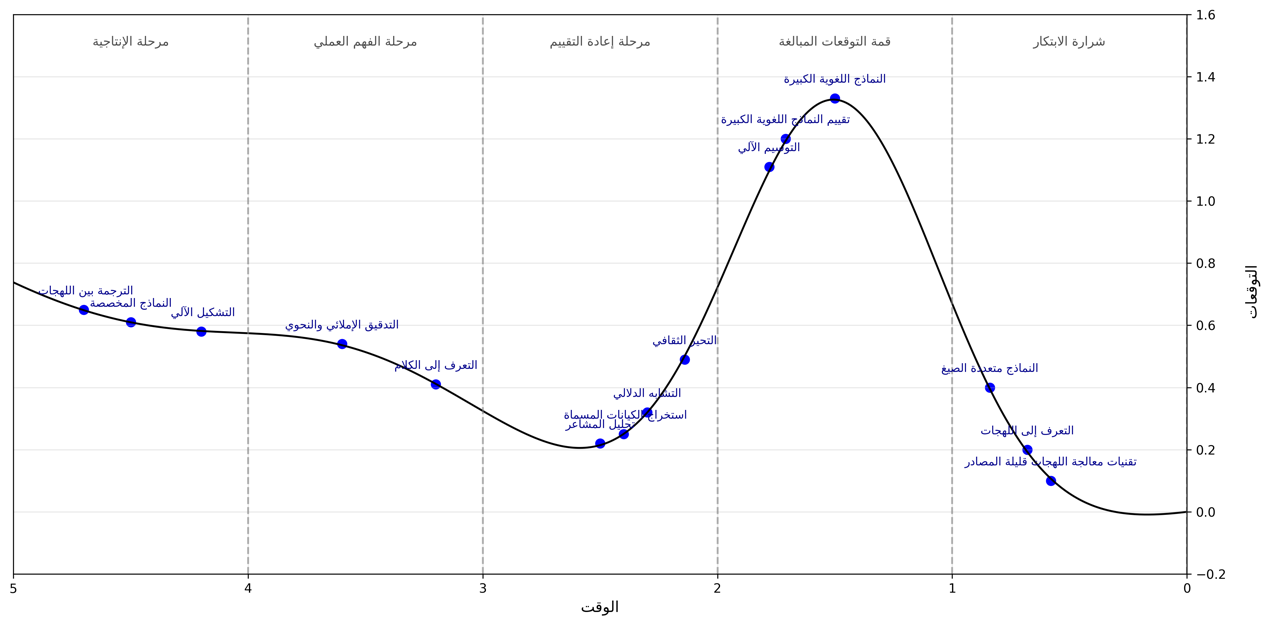
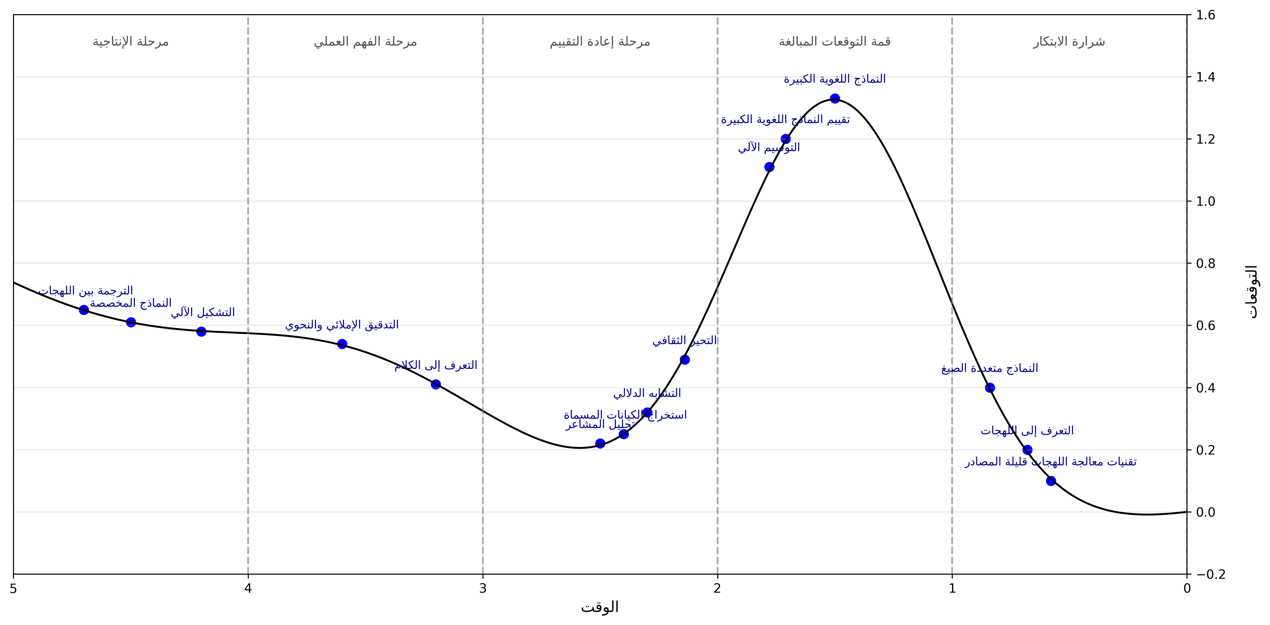
Hype curve in Arabic natural language processing for 2024
Tab select

The results also show that nearly 37% of participants believe that the tools do not meet the needs, while about 52% reported that the digital infrastructure does not support the requirements of their projects. Furthermore, 71% of participants acknowledged that research collaboration is ineffective. This assessment highlights a gap in collaborative efforts between the academic and industrial sectors, which leads to delays in translating research into practical applications.

The findings further reveal that around 25% of participants are satisfied with the quality of published research in this field, while nearly 78% noted that financial support and funding are insufficient. This was the highest-rated challenge, indicating that funding constitutes a major obstacle to progress in this area. The evaluation also shows that about 40% of participants are dissatisfied with the level of human capacity in Arabic NLP, pointing to a gap in the linguistic and technical skills required to support Arabic NLP projects.

Although 38% of participants relatively share their expertise and knowledge, this contribution is still insufficient to achieve the desired level of knowledge exchange, underscoring the need to strengthen efforts to increase both the scale and quality of knowledge sharing among specialists.

The 2024 Hype Cycle reflects the developmental trajectory of Arabic language processing technologies, from innovation to practical application. The field experienced high expectations, followed by technical challenges, and then stabilization of applicable solutions. Technologies such as dialect recognition and efficient resource processing emerged prominently, with expectations peaking following the launch of nine large language models, before a reassessment due to challenges such as cultural bias.

Nevertheless, some successful technologies have stabilized, such as spell checking and speech recognition, while others, such as specialized models and dialect-to-dialect translation, have reached a productivity stage. This reflects the maturity of the field and opens new opportunities. Despite this progress, challenges remain that require further research to ensure the accuracy and effectiveness of these technologies, including increasing labeled data, addressing linguistic and cultural bias in models, supporting dialects in tools, establishing ethical guidelines to protect data, and improving infrastructure.

Previous reports